
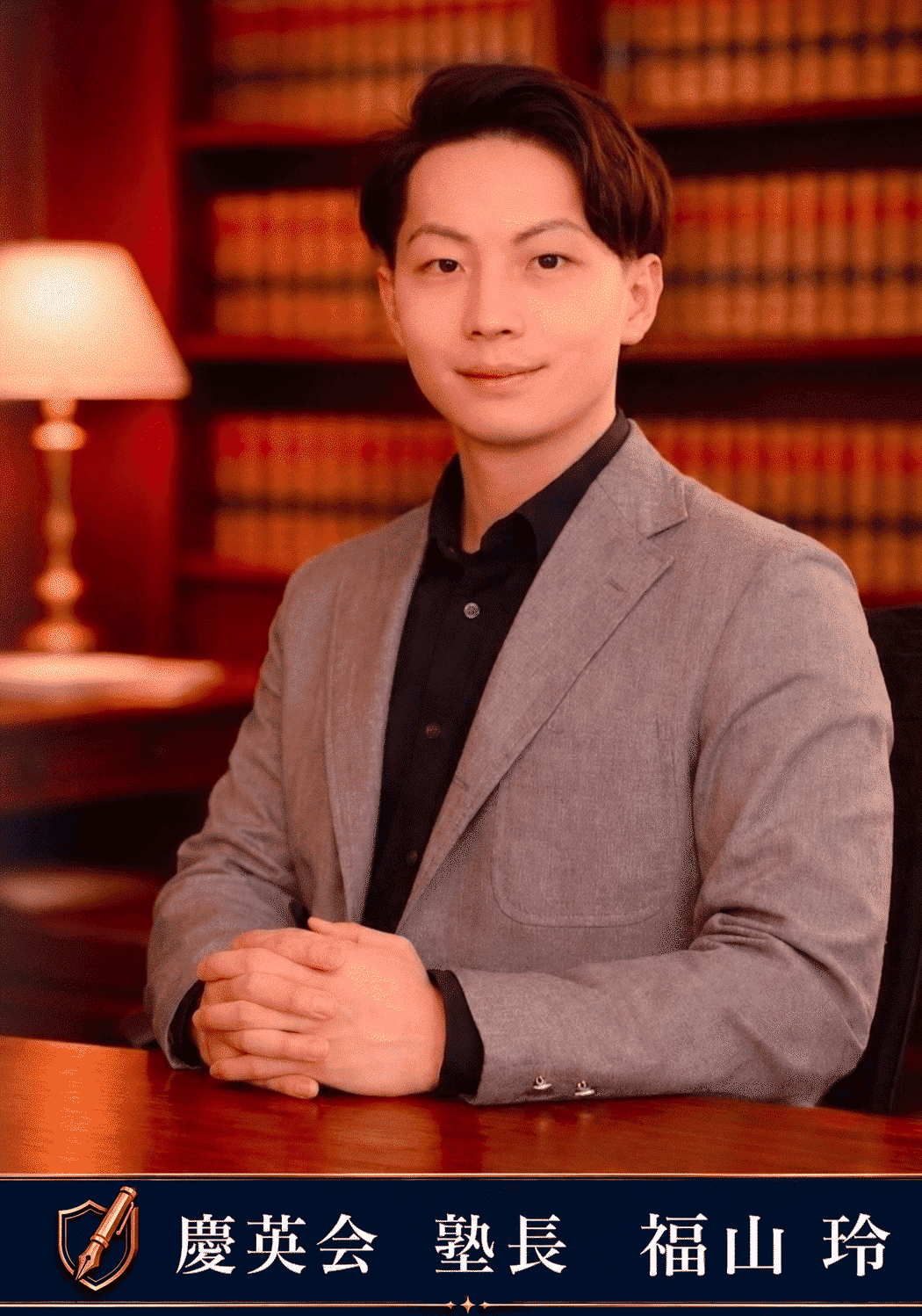

慶英会 塾長|慶應義塾大学卒・英検1級
中高一貫校の学校英語・NEW TREASURE・英検対策を専門とするオンライン個別指導塾です。塾長紹介
結論:英検1級のリスニングは、現行公式形式でPart1会話10問、Part2説明文10問、Part3 Real-Life5問、Part4インタビュー2問、合計27問です。このページでは、慶英会が独自制作した27問分の英文台本・4択・全解答・間違えやすい選択肢の解説を無料公開します。放送1回で聞き取るべき情報を、話者の意図・根拠・条件・例外に分けて練習してください。
重要:この教材に音声ファイルは付属しません。台本を最初は見ずに、講師・家族の読み上げまたは端末の読み上げ機能で練習し、答え合わせ後に台本を精読してください。英検協会の公式問題・公式模試ではなく、慶英会作成の短縮型独自演習です。公式音源での初見練習も別途行ってください。
出題形式は日本英語検定協会・1級の試験内容を確認。実際の過去問とPart1〜4の音源は英検1級公式過去問ページで公開されています。
Listeningの解答後は:Reading35問 / Writing2セット。本番の出題形式は英検協会の公式過去問と照合してください。
演習方法|1回目は音声、2回目は台本、3回目は言い換え
- 初回:問題と選択肢だけを読み、本文を隠して読み上げを1回聞く。聞き逃しても音声を戻さずに解答する。
- 復習:台本を開き、答えの根拠1か所と誤答3つの不一致を説明する。
- 再演習:台本を隠し、スピードを変えて条件・否定・話者の判断を再確認する。
- 注意:以下の架空の講座・施設・制度は練習用の設定です。実在機関の情報と混同しないでください。
Part1|会話内容一致・独自10問
Q1|研究補助金の計画変更
Question: What will the man most likely do?
- (A) Withdraw the proposal immediately.
- (B) Ask for all equipment expenses at the outset.
- (C) Revise the proposal to make later spending conditional on initial results.
- (D) Delay the research until an external laboratory agrees to fund it.
読み上げ用台本:Woman: You are still applying for the research grant, aren’t you? I thought the proposal deadline was Friday.
Man: It is, but the laboratory equipment is now more expensive than we anticipated.
Woman: So will you drop the project altogether?
Man: No. We’ll use the existing equipment for the preliminary phase and request the new equipment only if the first results justify it.
Woman: That sounds more realistic than requesting the entire budget at once.
Q2|図書館の夜間開館
Question: What does the man intend to do?
- (A) Consult the transport office about access to the library.
- (B) Cancel all evening library services permanently.
- (C) Launch a new advertising campaign immediately.
- (D) Move the library to another district.
読み上げ用台本:Man: The library has extended its hours, but the evening attendance is much lower than expected.
Woman: Perhaps people haven’t heard about the change.
Man: We advertised it throughout the district. Students say the late buses don’t connect with the library.
Woman: Then offering more hours alone won’t help them much.
Man: Exactly. I intend to speak with the transport office before proposing another extension.
Q3|展覧会の写真利用許諾
Question: What does the man emphasize?
- (A) Possessing the print automatically includes publication rights.
- (B) A preview file cannot be delivered until next month.
- (C) The photograph is unsuitable because of its poor composition.
- (D) Owning a copy is different from obtaining permission to reproduce it.
読み上げ用台本:Woman: Could we reproduce the photograph in the exhibition catalogue?
Man: The museum owns a print, but that doesn’t necessarily mean we hold publication rights.
Woman: Our designer needs the high-resolution file tomorrow.
Man: I can send a preview now. We should contact the rights holder before using it in a commercial publication.
Woman: Understood. The preview isn’t permission to publish.
Q4|人材研修の評価
Question: Why is the woman cautious about expanding the course?
- (A) The course content has not been translated.
- (B) The initial participants may not represent the intended wider audience.
- (C) The course received negative feedback from most volunteers.
- (D) The trainers refused to include beginners.
読み上げ用台本:Man: The training survey is overwhelmingly positive. Should we roll the course out to everyone?
Woman: The participants volunteered, and most already had strong technical skills.
Man: So the feedback may not represent the people who need the course most?
Woman: Precisely. I’d test it with beginners before expanding it.
Man: That means our next step is a more representative trial.
Q5|沿岸地域の環境測定
Question: What will the speakers do before making a public claim?
- (A) Close every monitoring station.
- (B) Check the unusual reading against equipment calibration and other stations.
- (C) Issue an immediate warning without further examination.
- (D) Discard all past environmental records.
読み上げ用台本:Woman: The coastal sensor network recorded an unusual rise last night.
Man: Should we announce that pollution levels are worsening?
Woman: Not until we verify the calibration. Two nearby stations recorded normal values.
Man: So we should check whether this is a malfunction rather than a regional trend.
Woman: Yes, and publish an update once the comparison is complete.
Q6|書籍の新刊予約
Question: What does the woman say about preordering?
- (A) It guarantees delivery on a specified Tuesday.
- (B) It is unavailable until the book appears in stores.
- (C) It requires an additional event ticket.
- (D) It secures a copy without guaranteeing the arrival date.
読み上げ用台本:Man: The new edition is available for preorder, but I can’t see a delivery date.
Woman: The publisher has confirmed the release week, not the day each shop will receive stock.
Man: Would a preorder guarantee arrival by Tuesday?
Woman: No, it only reserves a copy. We can notify you when it is dispatched.
Man: Then I’ll order it, but I won’t plan the event around Tuesday.
Q7|学術雑誌の査読
Question: What is the man’s proposed next step?
- (A) Request a correction to a specific statistical calculation before deciding.
- (B) Accept the paper without revision.
- (C) Ignore the third review because opinions differ.
- (D) Replace the study’s conclusions with the journal’s preferred position.
読み上げ用台本:Woman: We have three reviewers, but their recommendations conflict.
Man: One says the methods are sound; another wants the sample expanded.
Woman: The third identified an error in the way the confidence interval was calculated.
Man: Could we ask for a revision focusing on that calculation before judging the broader claims?
Woman: Yes. Rejecting the paper now might be premature.
Q8|公共討論の開催形式
Question: What does the woman recommend?
- (A) Restricting attendance to those who registered first.
- (B) Replacing public questions with a prerecorded speech.
- (C) Combining remote participation with alternatives for residents lacking internet access.
- (D) Cancelling the meeting because interest is too high.
読み上げ用台本:Man: The town meeting sold out in minutes. Should we add another room?
Woman: That would increase capacity, but residents unable to travel would still be excluded.
Man: Do you suggest live streaming?
Woman: Streaming with questions submitted in advance could help, provided we also arrange a way for people without internet access to participate.
Man: So we need more than a simple video feed.
Q9|省エネ投資の判断
Question: Why do the speakers postpone their conclusion?
- (A) Electricity consumption increased sharply.
- (B) The installation was free of charge.
- (C) The manufacturer withdrew the product.
- (D) The existing data do not yet establish the long-term financial return.
読み上げ用台本:Woman: Our new lights reduced electricity use, but the installation was costly.
Man: The savings report covers only the first six weeks.
Woman: So it is too early to say whether the investment will pay for itself?
Man: Exactly. We need maintenance estimates and a longer observation period.
Woman: I’ll update the report with those uncertainties.
Q10|通訳の発言確認
Question: What will the man do?
- (A) Change the caption to preserve the conditional nature of the statement.
- (B) Announce that the subsidy has been approved.
- (C) Remove all reference to the committee.
- (D) Tell the audience the review has already been completed.
読み上げ用台本:Man: The speaker said the subsidy was “subject to review.” Did that mean the funding had been approved?
Woman: Not necessarily. The committee may reconsider the amount or reject the request.
Man: I nearly wrote that approval was guaranteed.
Woman: In the summary, keep the condition explicit so the audience isn’t misled.
Man: Right. I’ll revise the caption.
Part2|説明文内容一致・独自5台本10問
説明文A|研究費配分と評価指標
読み上げ用台本:A research council once evaluated grant proposals mainly by counting the publications produced by each team. The approach was relatively easy to administer, but it rewarded quantity even when some projects required years of data collection. A new committee therefore proposed a broader review that considered transparent methods, the importance of the questions being asked and whether other researchers could examine the data. Critics warned that qualitative review might become inconsistent or overly dependent on reviewers’ preferences. The committee acknowledged this risk and recommended written criteria and an appeals process. Its aim was not to discard publication records completely, but to avoid treating a single easily measured figure as a complete description of research quality.
Q11. What weakness did the original funding system have?
- (A) It refused to consider publication records.
- (B) It could favour output quantity without adequately assessing research quality.
- (C) It placed too much weight on data transparency.
- (D) It gave every researcher the same grant automatically.
Q12. How did the committee respond to concerns about subjective review?
- (A) It abandoned the broader evaluation permanently.
- (B) It replaced all reviewers with publication counts.
- (C) It removed opportunities for researchers to appeal.
- (D) It proposed clear written criteria and a process for challenging decisions.
説明文B|都市の水循環
読み上げ用台本:In many cities, paved surfaces prevent rainwater from entering the soil. During heavy rainfall, water may flow rapidly into drainage systems, creating pressure on pipes and treatment facilities. Some planners advocate green roofs and permeable pavements as ways to slow runoff. Yet these measures do not eliminate flood risk, and their performance varies according to rainfall intensity and local maintenance. A city that installs such features without inspecting blocked drains may achieve less than anticipated. For this reason, engineers increasingly discuss them as components of a broader strategy that includes conventional infrastructure, regular monitoring and emergency planning.
Q13. Why might green infrastructure alone produce disappointing results?
- (A) Its effectiveness depends partly on conditions and maintenance of other systems.
- (B) It always causes more flooding than paved roads.
- (C) It completely prevents rainwater from reaching drains.
- (D) It can function only in areas without any buildings.
Q14. What approach is recommended overall?
- (A) Replace all drainage systems with green roofs immediately.
- (B) Ignore maintenance because plants are self-sustaining.
- (C) Combine green measures with infrastructure management and emergency planning.
- (D) Judge success solely by the number of pavements replaced.
説明文C|歴史資料のデジタル公開
読み上げ用台本:Digitizing historical collections allows researchers to examine manuscripts without travelling to the institutions that hold them. Search tools can also reveal links between documents that would otherwise take months to locate. Nevertheless, the availability of a digital image does not settle questions about how a text should be interpreted. Handwriting may be ambiguous, and letters that survive in an archive may represent only a small portion of the correspondence originally exchanged. Scholars therefore need to distinguish the evidence visible in surviving documents from broader conclusions about the people and events those documents concern. Digital access improves discovery, but it cannot remove every source of historical uncertainty.
Q15. What does digitization primarily improve in the passage?
- (A) The survival rate of all original correspondence.
- (B) The certainty of every historical interpretation.
- (C) The ability to discover and consult existing materials.
- (D) The reliability of all handwritten spellings.
Q16. What limitation remains even after digitization?
- (A) All manuscripts become inaccessible to experts.
- (B) Surviving documents may be incomplete or open to interpretation.
- (C) Every archive must stop displaying originals.
- (D) Scholars are forbidden from comparing records.
説明文D|企業の試験的勤務制度
読み上げ用台本:A company introduced a flexible working schedule in two departments and reported higher employee satisfaction. Managers considered applying the arrangement across the organization. However, the pilot involved teams whose work could be performed largely independently and whose supervisors had already supported flexible arrangements. Other departments required continuous customer coverage and close coordination. The company decided to expand the programme gradually, tracking service quality and employee workload as well as satisfaction. The initial results were useful, but management recognized that successful implementation could depend on the nature of the job and the resources available to each team.
Q17. Why did managers avoid immediate companywide adoption?
- (A) The pilot reduced satisfaction in every department.
- (B) The trial had covered only remote workers outside the company.
- (C) The law prohibited flexible schedules.
- (D) The participating departments differed in important ways from other teams.
Q18. Which measurement did the company add beyond satisfaction?
- (A) Service quality and employees’ workload.
- (B) Only the amount of office furniture purchased.
- (C) The number of advertisements released.
- (D) The managers’ personal preferences.
説明文E|言語学習の自己評価
読み上げ用台本:Learners often judge progress by how familiar a textbook passage feels after repeated reading. Familiarity can be useful because it reduces the effort needed to understand basic patterns. However, remembering an explanation is not the same as applying it to unfamiliar language. In one hypothetical teaching experiment, students completed an original exercise and later received a new text that tested similar reasoning with different examples. Teachers used the second task to find out whether knowledge transferred beyond the practised material. Their goal was not to eliminate review, but to separate recognition of old examples from independent comprehension.
Q19. What is the central limitation of relying on familiarity?
- (A) It makes learners forget every word they study.
- (B) It does not by itself show that learners can handle unfamiliar examples.
- (C) It guarantees that all new passages will be easy.
- (D) It prevents students from reviewing grammar.
Q20. Why did teachers introduce a new text?
- (A) To punish learners for recognizing the old exercise.
- (B) To stop all repeated reading.
- (C) To avoid measuring any comprehension.
- (D) To test whether understanding transferred to different material.
Part3|Real-Life形式・独自5場面5問
SituationとQuestionを先に読み、時刻・締切・対象資格・利用条件を短くメモしてから、本文を隠して聞いてください。条件が一つでも欠ける選択肢は消去します。
Q21|状況1|講座の修了証
Situation: You cannot attend on Thursday but can join a live workshop on Friday evening. You need a completion certificate.
Question: Which arrangement meets your needs, assuming you register on time?
- (A) Attend Thursday’s lecture only.
- (B) Watch Thursday’s recording and join Friday’s live workshop and quiz.
- (C) Watch only Saturday’s recorded workshop.
- (D) Join Friday’s workshop without completing the quiz.
読み上げ用台本:The city training centre offers three ways to learn. Thursday’s live introductory lecture is followed by a recording that becomes available on Friday morning. Participants who watch the recording may still receive a certificate if they attend Friday’s live workshop at seven and complete the final online quiz. Saturday’s recorded workshop is for personal study only and does not issue certificates. Registration for Friday closes at noon on Wednesday.
Q22|状況2|展示用画像の取得
Situation: You need a high-resolution image and permission to reproduce it in a printed catalogue. You cannot visit the museum.
Question: What should you do?
- (A) Download the free preview and print it without further permission.
- (B) Buy a postcard and scan it for the catalogue.
- (C) Reserve an appointment to view the original photograph.
- (D) Apply online for the high-resolution file and reproduction license.
読み上げ用台本:The museum’s website provides small preview files at no charge. Researchers can request high-resolution images by email, but print reproduction requires a separate license. The museum shop sells postcards for private use; buying one does not include reproduction rights. Applications for both the digital image and the license can be submitted online. The license must be approved before the catalogue is printed.
Q23|状況3|週末の公共研究参加
Situation: You are 17, have no previous research training, and can volunteer only on Sunday. A parent can sign a consent form.
Question: Which option is appropriate?
- (A) Sunday morning observations with signed parental consent.
- (B) Saturday laboratory work without an age exception.
- (C) Wednesday’s advanced field survey.
- (D) Monday evening data processing.
読み上げ用台本:Our environmental project runs several volunteer activities. The laboratory team meets on Saturday and accepts participants aged eighteen or older. Wednesday’s field survey requires advanced training. Sunday morning observations are open to newcomers aged sixteen and above. Participants under eighteen must bring a signed parental consent form. The remote data session takes place on Monday evening.
Q24|状況4|移動サービスの予約変更
Situation: You need wheelchair-accessible transport at 7 a.m. tomorrow and cannot use an ordinary taxi.
Question: What should you do before the office closes?
- (A) Reserve an ordinary online shuttle.
- (B) Wait until tomorrow morning to telephone.
- (C) Call the reservation desk to confirm the accessible 7 a.m. vehicle.
- (D) Book a regular late shuttle and assume it has accessibility equipment.
読み上げ用台本:The city shuttle operates accessible vehicles only on its early morning service. These vehicles leave at six thirty and seven on weekdays, but bookings must be confirmed by five the previous afternoon. The regular shuttle runs later without guaranteed wheelchair access. Today the office is open until five, and online booking is available only for standard vehicles. To request an accessible early service, callers must speak to the reservation desk.
Q25|状況5|研究資料の閲覧
Situation: You must examine a fragile original document tomorrow. A digital copy alone will not meet your research needs.
Question: What is the best conclusion?
- (A) The original can be accessed tomorrow without an appointment.
- (B) The original cannot be viewed tomorrow because the advance-approval deadline was missed.
- (C) The download automatically counts as examination of the original.
- (D) All original manuscripts are available on any weekend.
読み上げ用台本:The archive allows visitors to download digitized copies without an appointment. Original manuscripts in the general collection can be viewed at the reading room on weekdays. Fragile items, however, require specialist supervision, which is arranged only on Tuesdays and Thursdays after advance approval. Requests must be submitted two working days before the visit. Tomorrow is Thursday, but you have not submitted a request. The archive can provide additional scans today.
Part4|インタビュー・独自1本2問
Part4|都市建築の省エネ改修と公平性:独自インタビュー
読み上げ用インタビュー:Interviewer: Your team has been advising cities on energy upgrades for older apartment buildings. Why do you favour gradual retrofitting rather than replacing them entirely?
Guest: Replacement can sometimes be justified, but demolition produces waste and new construction requires significant resources. Many buildings can reduce energy use through improved insulation and better controls, provided their structural condition is sound. There is no universal solution.
Interviewer: Some local councils have announced impressive energy savings from pilot schemes. Can residents rely on those figures?
Guest: They can be informative, but we should ask how the results were measured. A mild winter or changes in occupancy might affect consumption independently of the renovation. Comparing similar buildings over several seasons gives us a more reliable picture.
Interviewer: What about the initial expense? Tenants with modest incomes may fear that landlords will pass costs on to them.
Guest: That is a legitimate concern. If a project lowers utility bills but sharply raises rent, the tenant might be worse off. Policymakers should therefore consider safeguards, transparent cost estimates and support targeted at buildings where residents have limited alternatives.
Interviewer: Some critics argue that all this evaluation will slow climate action.
Guest: It may slow a poorly prepared programme, but that is not necessarily a loss. A phased approach allows cities to learn from early projects. It can also build public confidence if residents see both the benefits and the trade-offs explained honestly.
Interviewer: So your argument is not against taking action quickly?
Guest: Not at all. It is against equating the number of renovated buildings with real progress. We should assess energy use, affordability and resident well-being together.
Q26. What is the guest’s main criticism of relying only on pilot energy-saving figures?
- (A) They are always fabricated by councils.
- (B) They prove that every replacement project is wasteful.
- (C) They show that weather never affects consumption.
- (D) They may reflect changes unrelated to renovation unless comparisons are carefully designed.
Q27. What does the guest say should guide the evaluation of retrofit policies?
- (A) The total number of renovated buildings alone.
- (B) Whether landlords gain the maximum possible rent.
- (C) Energy performance together with affordability and residents’ well-being.
- (D) The speed of demolition, regardless of living conditions.
27問の全解答一覧
Part1:Q1(C) / Q2(A) / Q3(D) / Q4(B) / Q5(B) / Q6(D) / Q7(A) / Q8(C) / Q9(D) / Q10(A)
Part2:Q11(B) / Q12(D) / Q13(A) / Q14(C) / Q15(C) / Q16(B) / Q17(D) / Q18(A) / Q19(B) / Q20(D)
Part3:Q21(B) / Q22(D) / Q23(A) / Q24(C) / Q25(B)
Part4:Q26(D) / Q27(C)
全27問の解説|正解の根拠と失点原因
Q1 正解(C)。No, We’ll use the existing equipment … request the new equipment only if … が根拠。予算削減というより段階的実施。
Q2 正解(A)。I intend to speak with the transport office と明示。広告不足は既に否定されている。
Q3 正解(D)。owns a print … doesn’t necessarily mean … publication rights が核心。物理的所有と利用許諾を区別。
Q4 正解(B)。volunteered と already had strong skills によるサンプルの偏り。初心者での再検証を提案。
Q5 正解(B)。verify the calibration と nearby stations の比較が先。異常値1件を地域全体に一般化しない。
Q6 正解(D)。only reserves a copy が根拠。到着日確約を否定している。
Q7 正解(A)。ask for a revision focusing on that calculation と明示。採否の前に算出方法を修正させる。
Q8 正解(C)。streaming with questions … provided … without internet access が条件付き提案。
Q9 正解(D)。six weeks・maintenance estimates・longer observation が未確定。省エネと投資回収を区別。
Q10 正解(A)。subject to review は承認確約ではないため条件を明記してキャプション修正。
Q11 正解(B)。counting publications rewarded quantity。
Q12 正解(D)。written criteria and an appeals process が対策。
Q13 正解(A)。varies according to rainfall intensity and maintenance と blocked drains に注意。
Q14 正解(C)。components of a broader strategy が結論。
Q15 正解(C)。allows researchers … without travelling と search tools が利点。
Q16 正解(B)。handwriting ambiguous と only a small portion survives が根拠。
Q17 正解(D)。work largely independently と customer coverage の差。
Q18 正解(A)。tracking service quality and employee workload が明示。
Q19 正解(B)。remembering an explanation is not the same as applying it。
Q20 正解(D)。transferred beyond the practised material が核心。
Q21 正解(B)。木曜は録画で代替可、金曜19時のライブとクイズが修了証の条件。
Q22 正解(D)。高解像度ファイルと印刷許諾の両方が必要で、オンラインで申請できる。
Q23 正解(A)。日曜・16歳以上・初回可・18歳未満は保護者同意、4条件の一致。
Q24 正解(C)。early accessible vehicle は前日17時までに電話窓口で要予約。
Q25 正解(B)。木曜の監督員対応日だが、2営業日前の申請が未了。追加スキャンは原物閲覧の代替ではない。
Q26 正解(D)。mild winter / occupancy might affect consumption independently が根拠。
Q27 正解(C)。最後の assess energy use, affordability and resident well-being together と一致。
パート別の復習戦略
Part1:話し手の最終判断を優先する
最初に提案された選択肢が最終結論とは限りません。No, instead, provided that, before, not necessarily の後で方針が修正される箇所を聞きます。「最初の意見→相手の懸念→最終判断」を日本語1行で再構成してください。
Part2:説明文の「主張・留保・対策」の関係を読む
数字や固有名詞の暗記ではなく、何が問題視され、どの条件で主張が成立するかを整理します。例えば Part2の研究費評価では、論文数を完全に廃止するのではなく、単一の指標だけに依存しないという結論が重要です。
Part3:絶対条件と不一致の理由を照合する
only, however, must, by, unless, no longer のような条件語が答えを分けます。時間・方法・資格・証明書などを必要条件としてメモし、満たさない選択肢を順に削除します。
Part4:インタビューの立場と限定を区別する
guestが主張しているのは「省エネをやめる」ではなく「条件・費用・公平性も同時評価する」です。賛成・反対の単純な二分法に還元せず、譲歩と主張の範囲をまとめてください。
間違えた問題の7日間復習法
- 1日目:聞き間違えを音声知覚・語義・条件保持・選択肢判定の4種類に分けて記録する。
- 2日目:元の台本を見て接続語と否定語を確認し、1文ずつ意味を説明する。
- 3日目:自分で台本を朗読・録音して、弱形や語の連結を確かめる。
- 5日目:選択肢を見ずに、話し手の最終判断を1文で説明する。
- 7日目:公式の未使用音源または初見の別教材で転移を確認する。得点を公式CSEに換算しない。
よくある質問
英検1級のリスニングは27問ですか?
現在の公式形式ではPart1が10問、Part2が10問、Part3が5問、Part4が2問で計27問です。公式では放送1回、リスニング時間の目安は約35分です。実施回の情報は必ず公式案内で確認してください。
このページにリスニング音声はありますか?
本教材には音声ファイルがありません。台本を隠して第三者の読み上げや端末の音声読み上げを利用し、正解後にスクリプトを精読してください。実際のスピードや発音での演習には協会の公式音源を併用します。
27問で何点なら英検1級に合格できますか?
本教材の正答数は公式の素点や英検CSEスコアではありません。英検1級の一次試験はReading・Writing・Listeningを合わせて判定するため、独自練習問題の点数だけで合否は判断できません。
次に読む無料教材
- 英検1級Part3 Real-Lifeの条件整理:独自16場面と全解答
- 英検1級Part1〜4の先読み・メモ・独自32題
- 英検1級の連結・弱形・短縮24例
- 英検1級Reading35問の無料総合演習
- 英検1級12週間ロードマップ
慶英会の英検1級学習相談
聞き取れたつもりなのに選択肢を誤る場合は、音声知覚と論理理解を分けて原因を確認する必要があります。慶英会では、台本や答案から失点傾向を整理する個別指導・学習相談を受け付けています。最大1か月無料体験・学習相談はこちら。
参考にした主な公式情報:日本英語検定協会・1級の試験内容、1級過去問・音源。問題文・会話・人物・施設・制度は全て慶英会の練習用独自作成であり、英検協会の放送原稿ではありません。
最大1か月完全無料体験・学習相談受付中
最大1か月の完全無料体験をご案内
学校教材・学力・目標に合わせた個別指導
入塾前に授業の進め方や講師との相性をお確かめください。
学校英語・定期テスト・英検の学習相談にも対応します。
保護者様の教育相談も無料で承ります。
1.学年 2. 学習目標 3.体験ご希望をお送りください。
体験の期間・回数・担当講師・日程は、ご希望と受付状況を確認してご案内します。
慶英会 塾長|慶應義塾大学卒・英検1級。中高一貫校の学校英語・NEW TREASURE・英検対策を専門としています。塾長の経歴・指導方針を確認する